
Call before you hire an excavator or buy a tank. We will ask about sewer service, the parcel number, the proposed building, the plot plan, and any CDH records you already have. Central District Health reviews individual systems in Ada and Boise counties.
First, check for sewer service
Boise has a large municipal sewer network. The City map shows general service boundaries, but it does not identify every connected address. An older home may still use septic inside a mapped area, and a nearby line may not be available to a rural parcel.
Check the utility account and search CDH records. If an old street address produces no file, search by legal description. CDH says its online records begin in 1971 and some pre-2000 Ada County files did not transfer cleanly. A blank search result is a reason to request the file, not proof that no permit exists.
- Street address and parcel number
- Legal description, subdivision, lot, and block
- Current sewer provider or availability information
- Existing permit and as-built drawing
What CDH needs with the application
The plot plan must show the current and proposed buildings, wells, water lines, roads, streams, ditches, scarps, existing septic parts, proposed field, and a full future replacement field. New homes also need floor plans because bedrooms and design flow affect tank and field size.
CDH also lists owner identity and lawful-presence paperwork in its current instructions. We can help organize the contractor documents, but the owner remains responsible for a complete submission and the agency fee.
- Signed application
- Scaled or fully dimensioned plot plan
- Floor plan for a new dwelling
- Current fee and required owner documents
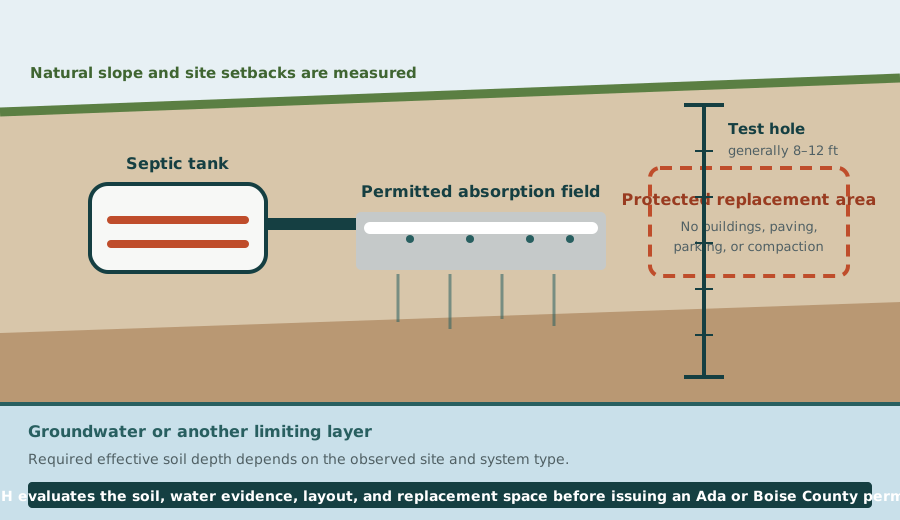
Test holes show what the soil can handle
Test holes are generally 8–12 feet deep and go near the proposed field. The owner or agent hires the excavator and coordinates the appointment. A CDH Environmental Health Specialist observes the open soil profile; CDH does not supply the machine or labor.
Claypan, duripan, hardpan, organic muck, high shrink-swell clay, and some coarse material can rule out a standard system. Groundwater, rock, an impermeable layer, slope, and usable area may move the field, change its size, require another design, or prevent approval.
Groundwater can add months to the job
CDH may require weekly readings from February 15 through June 30. Irrigated land may also need readings from April 15 through October 31. A dry summer hole cannot show the highest water level the drainfield must handle.
CDH posted a 2026 drought warning that abnormally low readings may need to be repeated in a more representative year. If you are buying land or setting a build date, ask the assigned specialist what remains outstanding before relying on a schedule.
Current fees and final inspection
As of July 2026, CDH lists $1,070 for a new permit with a test hole or site visit and $535 for several no-visit scopes, including tank-only work. A repair with a test hole is also $1,070; a repair without one is $535. These are agency fees and may change.
After CDH issues the permit, a properly registered installer builds to the approved drawing. CDH inspects the work before wastewater enters a new system and completes the as-built record. Call us for the construction side; call CDH at 208-327-7499 for the official ruling.